Why Only One Muscle Gets Sore After a Full-Body Session
Quick Answer: Soreness concentrates in specific muscles for two main reasons: that muscle was loaded eccentrically more than the others, and it was less adapted to the movement than the others. A full-body session that leaves only your hamstrings sore usually means the hamstrings did the most lengthening-under-load work and are the least trained relative to the demand. It is useful information about your training gaps rather than a sign the session was uneven.
You trained everything. Two days later only your hamstrings hurt, and they hurt a lot.
That pattern is telling you something specific about which muscles are behind, and it is more useful than a general soreness score.
This is general information, not medical advice.

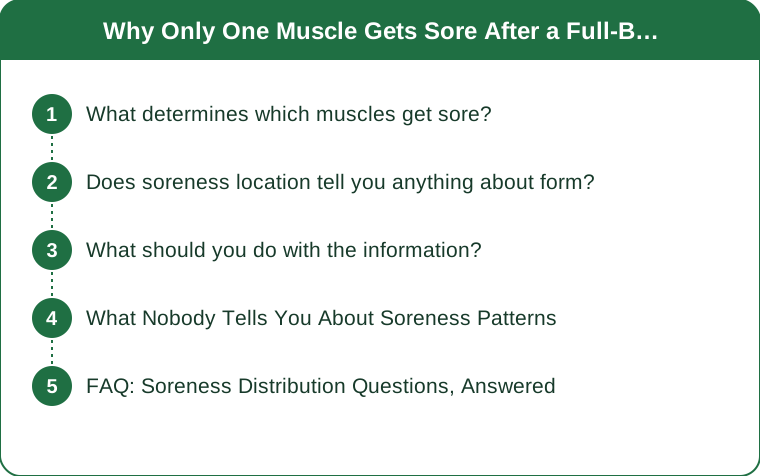
What determines which muscles get sore?
Two factors, and they multiply rather than add.
Eccentric load is the first. An eccentric contraction is one where the muscle produces force while lengthening - the lowering phase of a curl, the descent of a squat, the deceleration when your foot lands. Eccentric contractions produce substantially more delayed onset muscle soreness than concentric ones at matched effort. This is one of the most consistent findings in the soreness literature.
Which means a movement’s eccentric component determines its soreness potential, not its difficulty. Romanian deadlifts load the hamstrings eccentrically through a long range; leg curls do so far less. Same muscle, very different next-day result.
Adaptation level is the second. The repeated bout effect means a muscle that has performed a movement recently is substantially protected from soreness on repetition. A muscle you train regularly will not get sore from your regular training - it is adapted.
So concentrated soreness in one muscle means both conditions met there: it took significant eccentric load and it was not adapted to it.
Which is genuinely useful information. In a full-body session where only one muscle is sore, that muscle is your relative weak point for the movements you performed. Not weakest in absolute terms - least adapted to what you just did.
A common example: someone who runs regularly and then does their first set of walking lunges. Quads are trained; glutes and adductors are not loaded that way by running. The soreness distribution maps the gap precisely.
Does soreness location tell you anything about form?
Sometimes, and it is worth interpreting carefully.
Feeling a movement in an unexpected muscle can indicate a technique issue - a squat that produces only quad soreness and no glute involvement may suggest a movement pattern that is not loading the hips. But this is suggestive rather than diagnostic.
Individual anatomy varies substantially. Limb proportions, hip structure and attachment points all change which muscles do what in a given movement. Two people with identical technique can experience different muscle emphasis in the same squat.
What is more clearly informative:
- Strongly asymmetric soreness - one side markedly sorer than the other. This more reliably suggests uneven loading, and is worth filming a set to check
- Soreness in a muscle that should not be involved at all, which may indicate a compensation pattern
- Joint discomfort rather than muscle soreness, which is a different signal entirely and worth attention
What is not informative:
- Absence of soreness in a muscle you trained. It probably means that muscle is adapted, which is a good thing
- A muscle being sore after its first exposure to a movement. That is expected and says nothing about form
The most useful framing: soreness distribution after a novel session is a map of your training gaps. Soreness distribution after a familiar session is more likely to be about form or about a genuine change in how you performed it.

What should you do with the information?
Address the gap gradually, and do not chase the soreness.
If a muscle is consistently the sore one, it is undertrained relative to the demand. The response is to train it more directly and more often - which, once it adapts, will make it stop being sore. That is the point.
How to actually do it:
- Add a direct movement for that muscle early in your session while fresh
- Start conservatively - the first exposure will be sore regardless
- Repeat the same movement for several weeks rather than rotating, so adaptation can occur
- Progress load gradually once soreness from that movement has diminished
What not to do: keep changing exercises to keep producing soreness. This is the most common error, and it guarantees you are permanently unadapted to everything. Progress requires repeating a stimulus, and reduced soreness is evidence that it is working.
On training a sore muscle: light to moderate training of a sore muscle is generally fine and often reduces the discomfort temporarily. Heavy loading of a significantly sore muscle is worth postponing - performance is reduced and the quality of the session suffers.
On the repeated bout effect timeline: protection appears after a single exposure and lasts for several weeks, with some evidence of partial protection persisting longer. Which is why returning to a movement after a two-month break produces soreness again, though usually less than the very first time.
The general principle: soreness is a signal about novelty, and its disappearance is a signal about adaptation. Adaptation is what you are training for.
What Nobody Tells You About Soreness Patterns
Five observations that change how you read it.
Downhill running is the fastest way to produce quad soreness. Descending is almost entirely eccentric work for the quads, which is why a hilly run produces soreness a flat run of the same distance does not. If you got unexpectedly sore quads, check whether the route changed.
Soreness peaks later than most people expect. The 48-hour mark is often worse than the 24-hour mark, which catches people out when they plan a hard session for the day after. Planning around the peak matters more than planning around the first day.
Absence of soreness is not absence of stimulus. Well-adapted muscles produce almost no soreness at productive training loads. Experienced lifters routinely train hard and are not sore, and it is not a sign they are underdoing it.
Asymmetric soreness deserves a look. Consistently sorer on one side suggests uneven loading, which is worth filming a set to check. It is one of the few soreness patterns that reliably points at a technique issue.
The muscle that hurts is not always the muscle that worked hardest. Soreness reflects the combination of eccentric load and lack of adaptation. Your strongest muscle can be the sorest one if the movement loaded it in an unfamiliar way.
FAQ: Soreness Distribution Questions, Answered
Why do I only ever get sore in one muscle group?
That group is the least adapted to the eccentric demands of your training, and the others have already adapted. Train that muscle more consistently and it will stop being the sore one - which is the goal, not a loss.
Is it bad that I do not get sore any more?
No - it usually means you are adapted to your training. Soreness tracks novelty rather than effectiveness. Use performance over weeks as your feedback instead.
One side is much sorer than the other. Should I worry?
Worth investigating rather than worrying. Film a set to check whether loading is even, and consider whether a previous injury has left you favouring one side. Consistent asymmetry is one of the more meaningful soreness signals.
Should I train a sore muscle?
Light to moderate work is generally fine and often reduces discomfort. Postpone heavy loading of a significantly sore muscle - the session quality will be poor and there is no benefit to forcing it.
Why am I sorer after a session that felt easier?
Because soreness tracks eccentric load and novelty, not perceived effort. An easy-feeling session with lots of controlled lowering or unfamiliar movement patterns will out-sore a hard session of familiar work every time.
How long should soreness last?
Typically peaking at 24-72 hours and resolving within about five days. Beyond a week, or if it is sharp, localised, or in a joint rather than a muscle, that is worth having looked at.
TL;DR:
- Soreness concentrates where eccentric load was high and adaptation was low - both conditions have to be met
- Concentrated soreness in one muscle maps your training gap for those specific movements
- Absence of soreness in a trained muscle usually means it is adapted, which is good
- Asymmetric soreness is the pattern most worth investigating for technique
- Repeat movements to adapt rather than rotating exercises to keep producing soreness
- Soreness often peaks at 48 hours, not 24 - plan the following session around that
The sore muscle is telling you what you have been neglecting. Train it until it stops.
Keep Reading
This article is for general informational purposes only and is not medical advice. Always consult a qualified health professional for guidance specific to you.