How to Tell DOMS From an Actual Injury
Quick Answer: DOMS is diffuse, symmetrical, arrives 12 to 48 hours later, feels worse when you first move and better once you are warm, and improves every day. An injury is usually sharp and localized to a point you can put a finger on, often started during the session with a specific moment, is frequently one-sided, and gets worse with activity rather than better. Swelling, bruising, weakness, or pain at rest all point away from DOMS.
You trained legs on Sunday, and now on Tuesday one hamstring is unhappy in a way the other one is not. Somewhere between reassuring yourself it is just soreness and convincing yourself you have torn something, there is an actual set of distinguishing features. Here they are.

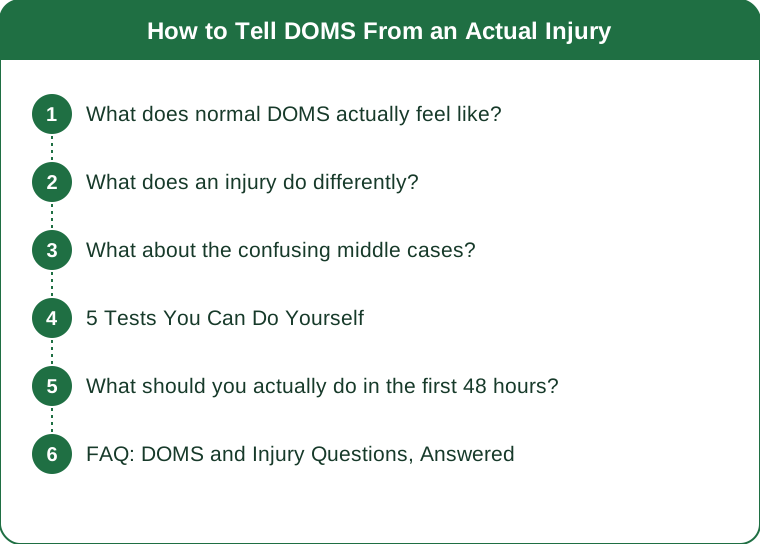
What does normal DOMS actually feel like?
Delayed. It shows up 12 to 24 hours after training, peaks around 24 to 72 hours, and resolves within about five days. Pain that arrived instantly during a rep is not DOMS.
Diffuse. It covers a whole muscle or muscle group. You cannot point to it precisely - you can only put a hand over the area.
Symmetrical, usually. If you trained both legs, both legs hurt. Notably one-sided soreness after a symmetrical session is worth a second look.
Worse cold, better warm. The classic pattern is stiffness getting out of a chair or down the stairs, which eases substantially after ten minutes of moving. This is one of the most useful single tests.
Improving daily. Day three should be better than day two. A soreness that plateaus for several days or worsens is behaving wrongly.
And it does not really weaken you in a way that matters. Strength is temporarily reduced, but you can produce force. You are uncomfortable, not unable.
What does an injury do differently?
It usually has a moment. Most strains can be traced to a specific rep, a specific step, or a sensation people describe as a pull, a pop, or a catch. If you can remember when it happened, that is meaningful.
It is localized. You can put one finger on it. Point tenderness in a specific spot, particularly near a joint or at the junction between muscle and tendon, is the most reliable single difference.
It gets worse with use, not better. Warming up improves DOMS and typically aggravates a strain after an initial deceptive easing.
It often comes with something extra. Swelling, bruising appearing over a day or two, warmth, a visible dent or lump, or a definite loss of strength.
And it is more likely to hurt at rest. DOMS is quiet while you sit still. Pain that wakes you or aches while you are doing nothing is a different signal.
Any pain in a joint rather than a muscle belly deserves separate consideration entirely - DOMS is a muscle phenomenon, and joint pain has never been a normal training consequence.
What about the confusing middle cases?
One-sided DOMS after a genuinely one-sided session is normal. Lunges, single-leg work, or a new sport with a dominant side will produce asymmetric soreness legitimately.
Soreness near a tendon after unaccustomed loading can be either. Achilles and patellar tendon discomfort after a big jump in volume sits genuinely in the middle. The deciding factor is behaviour over a week: settling means it was overload, persisting or worsening means it is tendinopathy and needs managing rather than resting.
Extreme soreness after a first session back is common and usually fine - but severe, disproportionate soreness with dark urine, significant swelling, and pain far beyond normal is the picture of rhabdomyolysis, which is a medical emergency. It is rare, but it is most associated with exactly the scenario people put themselves in: an extremely hard first session after time off, particularly in heat.
Cramping is a third thing entirely and is not a useful signal about either.
When it is genuinely ambiguous, the test is time. Two easy days. DOMS resolves; an injury announces itself.

5 Tests You Can Do Yourself
1. The finger test. Can you point to it with one fingertip, or do you need a whole hand? One fingertip leans injury.
2. The warm-up test. Ten minutes of easy movement. Better means DOMS. Worse, or better then sharply worse, leans injury.
3. The symmetry test. Did you train both sides equally? If yes, and only one side hurts, take it seriously.
4. The strength test. Contract the muscle gently against no resistance, then against light resistance. DOMS is uncomfortable through the range. A strain typically produces a sharp catch at a specific point, and noticeable weakness.
5. The trajectory test. Rate it out of ten each morning. Three consecutive mornings that are not improving is the point to stop self-assessing.
None of these are diagnostic on their own. Two or three of them pointing the same way is what matters, and the trajectory test is the one that settles most cases.
What should you actually do in the first 48 hours?
If it looks like DOMS: keep moving gently and train around it. Light activity increases blood flow and genuinely reduces soreness. Complete rest tends to prolong it.
Train the sore muscle lightly if you want to. Working out with DOMS is safe, and a lighter session often reduces the soreness for several hours. Just do not add load or chase a personal best.
Sleep and eat properly, particularly protein. Recovery is not a passive process and it has requirements.
If it looks like an injury: stop loading it, and do not stretch it aggressively. Stretching a fresh strain is one of the more common ways people extend the recovery timeline.
Ice is optional and mostly for comfort. The evidence for it accelerating healing is weak; the evidence for it reducing pain in the short term is reasonable.
See someone if: you heard or felt a pop, you cannot bear weight, there is visible swelling or bruising, there is a definite loss of strength, or it is not improving after five to seven days. Also see someone for any joint pain, regardless of how it started.
FAQ: DOMS and Injury Questions, Answered
Is more soreness a sign of a better workout?
No. Soreness tracks novelty and eccentric loading, not effectiveness. Experienced lifters making excellent progress are often not sore at all, and a session that leaves you unable to walk properly is usually just a poorly judged jump in volume.
Can DOMS last more than a week?
Occasionally, after a genuinely extreme or very novel session, but it is unusual. Soreness that is still significant at day seven should be reassessed rather than waited out.
Should I stretch when I have DOMS?
Gentle movement helps; hard static stretching of a sore muscle does not reduce DOMS and can aggravate it. Light mobility work through comfortable ranges is the useful version.
This is general information, not medical advice. Sudden severe pain, an audible pop, visible deformity, or inability to bear weight needs prompt medical attention.
TL;DR:
- DOMS is delayed, diffuse, usually symmetrical, better once warm, and improving every day.
- An injury usually has a moment you remember, a point you can cover with one fingertip, and gets worse with use.
- Swelling, bruising, definite weakness, pain at rest, or any joint pain all point away from normal soreness.
- Use the finger, warm-up, symmetry, strength, and trajectory tests together, and stop self-assessing after three mornings without improvement.
One hamstring hurting after a two-legged session is the detail worth paying attention to. Give it two easy days, watch the trajectory, and let the pattern tell you which one it is.
Keep Reading
This article is for general informational purposes only and is not medical advice. Always consult a qualified health professional for guidance specific to you.