Does Caffeine Actually Reduce Muscle Soreness?
Quick Answer: Several studies show caffeine reduces perceived soreness after eccentric exercise, typically at doses around 5mg per kilogram of body weight taken before training or in the days following. The effect is real but modest - roughly a reduction in reported pain rather than a removal of it - and it works by blunting pain perception, not by speeding tissue repair. A single cup of coffee is likely below the effective dose for most people.
It is one of the few soreness interventions with more than anecdote behind it, which is precisely why the claim gets overstated.

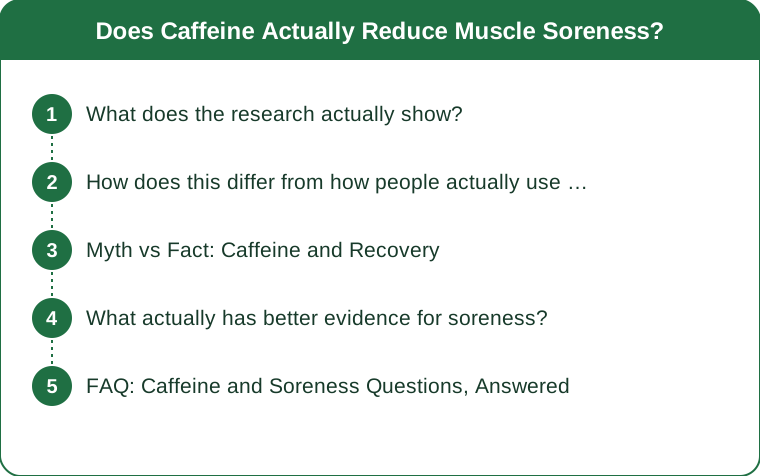
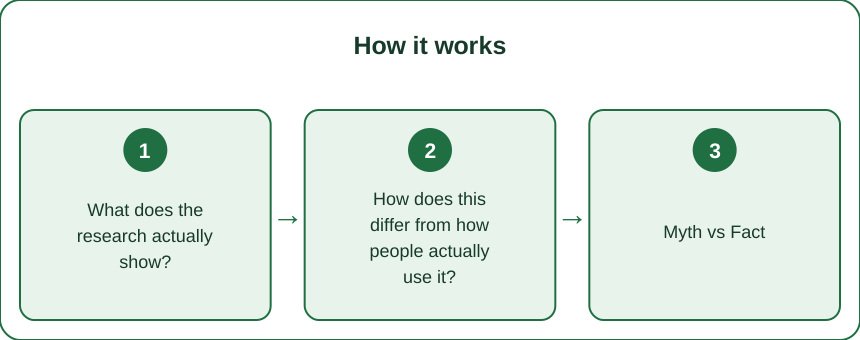
What does the research actually show?
The strongest findings come from studies using caffeine before eccentric exercise. Eccentric work - lowering phases, downhill running - is what reliably produces delayed onset muscle soreness, so it is what researchers use to induce it.
Doses in the literature cluster around 5mg per kilogram of body weight. For a 65kg person that is roughly 325mg, which is around three cups of brewed coffee. Studies using much lower doses tend to find much weaker effects.
The measured outcome is usually perceived soreness on a rating scale, and typical reductions land in the range of a modest but statistically meaningful improvement. Some studies also show better force retention in the days after.
Mechanism: adenosine receptor antagonism. Caffeine blocks adenosine receptors, and adenosine is involved in pain signalling. So the plausible mechanism is a reduction in how much pain you perceive, not a change in the underlying muscle damage.
Which matters for what you should conclude. Feeling less sore is genuinely valuable, but it is not the same as recovering faster, and it can mask a signal you might want.
How does this differ from how people actually use it?
Most people drink coffee the morning after, when they are already sore. The research protocols more often dose before the training session, or consistently across the days that follow.
A single cup is typically 80 to 120mg, well under the doses used in the studies showing an effect. If you want to approximate the research, you are looking at two to three cups or a measured supplement dose.
Habitual caffeine users may see reduced effects. Tolerance to caffeine’s ergogenic and analgesic effects develops, though the evidence on how much is mixed. Some studies suggest a short withdrawal period restores sensitivity, but that trade is rarely worth it for a modest soreness benefit.
Timing relative to sleep is the real cost. Caffeine’s half-life is around five hours, longer in some people. An afternoon dose large enough to affect soreness is large enough to affect sleep, and sleep is a far bigger lever for recovery than caffeine is.
Which is the honest summary: if you already drink coffee in the morning, having it before a session is a reasonable free addition. Adding a large late dose specifically for soreness is a poor trade.

Myth vs Fact: Caffeine and Recovery
Myth: Caffeine speeds muscle repair. Fact: The evidence points to reduced pain perception, not accelerated tissue healing. Those are different things and the distinction matters if you are deciding whether to train on a sore day.
Myth: Caffeine dehydrates you and worsens soreness. Fact: The diuretic effect of caffeine at normal intakes is mild and largely offset by the fluid in the drink itself. Habitual consumers show minimal net effect. This is one of the more persistent myths in the category.
Myth: Pre-workout supplements give you the benefit automatically. Fact: Many contain 150 to 300mg, so some do land near the effective range. But they are also usually taken before every session, which is the tolerance scenario. Check the actual dose rather than assuming.
Myth: If you feel less sore, you recovered better. Fact: Soreness is a poor proxy for recovery generally, and this is exactly the case where it becomes misleading. Masking soreness with caffeine while performance is still down is how people accumulate fatigue.
Myth: More is better. Fact: Above roughly 6mg per kilogram, side effects rise sharply - jitteriness, elevated heart rate, disrupted sleep - without corresponding benefit. High doses are also genuinely unsafe for some people.
What actually has better evidence for soreness?
Sleep, by a considerable margin. Sleep restriction consistently worsens perceived soreness and impairs recovery markers. Nothing in the supplement aisle competes with an extra hour.
Continued light movement. Active recovery - easy walking, easy cycling, light versions of the same movement - reliably reduces soreness in the following days. It remains one of the best-supported interventions and it is free.
Adequate protein and total calories. Not a soreness intervention as such, but under-eating reliably prolongs the whole recovery process.
Progressive exposure. The repeated bout effect is the strongest phenomenon in this whole field. Doing a modest version of the same eccentric work provides substantial protection against soreness the next time, and the protection lasts weeks.
And the interventions with weaker evidence than their reputation: static stretching after training, foam rolling for anything beyond short-term perceived relief, and most cold water immersion protocols - which may reduce soreness but appear to blunt some training adaptations if used routinely after strength work.
FAQ: Caffeine and Soreness Questions, Answered
Should I take caffeine before or after a workout for soreness?
The research more commonly uses pre-exercise dosing, and that also gives you the performance benefit. Post-exercise dosing for soreness specifically has less support and carries the sleep cost.
Does it matter whether it is coffee or a supplement?
For the caffeine effect, no. Coffee contains other compounds including polyphenols that may have their own modest effects, and some research on tart cherry and other polyphenol sources is mildly positive. If you enjoy coffee, use coffee.
Is it safe to take 5mg per kilogram?
For most healthy adults, that falls within commonly cited safe daily intake ranges, but individual sensitivity varies enormously and it is a substantial single dose. If you have a heart condition, high blood pressure, anxiety, are pregnant, or take medication that interacts with caffeine, talk to a healthcare provider first. This is general information, not medical advice.
TL;DR:
- The effect is real but modest, and it comes from blunting pain perception rather than speeding tissue repair.
- Research doses cluster around 5mg per kilogram - roughly three cups of coffee - taken before training.
- One cup after a sore night is almost certainly below the effective dose.
- The sleep cost of a large late dose outweighs the soreness benefit, and sleep is the bigger recovery lever anyway.
- Light movement and progressive exposure to the same eccentric work both beat caffeine on evidence.
If you already drink coffee before training, you are getting whatever benefit exists for free. That is about as far as the evidence takes it.
Keep Reading
This article is for general informational purposes only and is not medical advice. Always consult a qualified health professional for guidance specific to you.