Why Soreness Arrives Later When the Weather Turns
Quick Answer: Soreness timing shifts in cooler weather mainly because your warm-up is now less adequate for the session, your post-session movement drops, and you sleep differently. The underlying delayed-onset process has a wide normal window of 24 to 72 hours, and small changes in warm-up quality and subsequent activity move you within it.
The session felt the same. The weight on the bar was the same.
Tuesday you felt fine and thought you had got away with it. Wednesday morning you could not get down the stairs properly.
That shift is real, common, and mostly explainable.

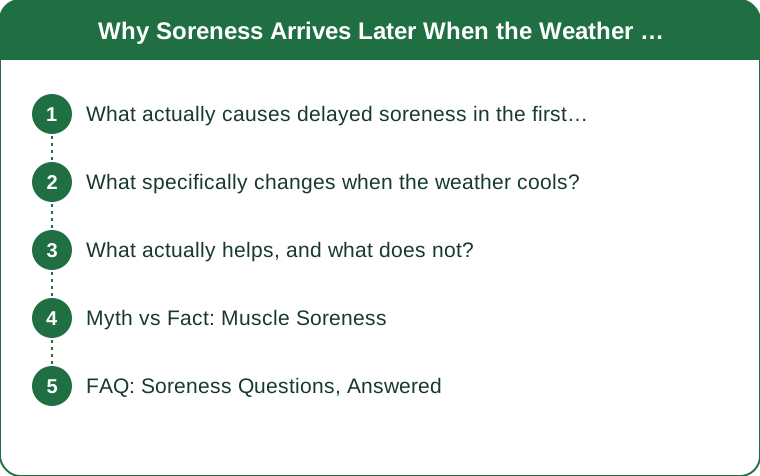
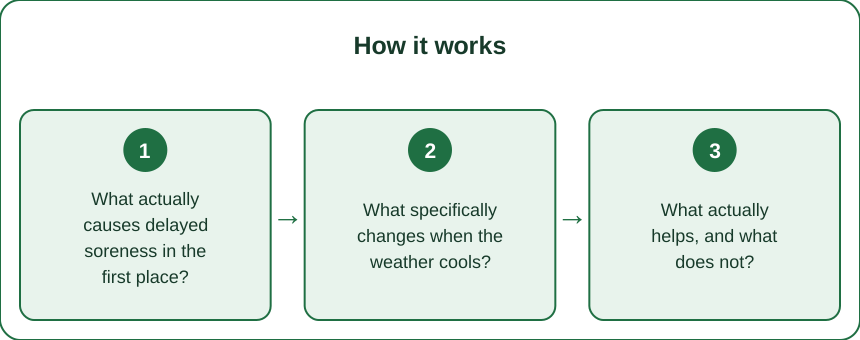
What actually causes delayed soreness in the first place?
It is worth clearing up, because the popular explanation is wrong and the wrong explanation leads to the wrong responses.
It is not lactic acid. Lactate clears from muscle within roughly an hour of exercise. It has nothing to do with an ache that peaks two days later. This idea has been out of date in the research literature for decades and remains the single most common thing people believe about soreness.
The current understanding centres on mechanical damage to muscle fibres, particularly from eccentric contractions — the lengthening phase, like the descent of a squat or the downhill portion of a run. That microdamage triggers an inflammatory response, and the inflammatory process plus the associated swelling and sensitisation of local nerve endings is what you feel.
The timeline follows the inflammatory response rather than the exercise: onset typically 12 to 24 hours after the session, peak somewhere between 24 and 72 hours, resolution by five to seven days.
That is a wide window, and where you land in it varies with the session, your training history, sleep, and how much you move in the days after. A shift from a day-two peak to a day-three peak is comfortably within normal variation and is not a sign that anything has gone wrong.
Two useful implications: soreness is a poor measure of how good a session was, and the absence of soreness in a well-trained person is expected rather than concerning — the repeated bout effect means a familiar stimulus produces much less damage the second and subsequent times.
What specifically changes when the weather cools?
Four things, and none of them are the temperature acting directly on your muscles.
Your warm-up is now inadequate for the session. The same five minutes that prepared you in July does not prepare you at 14°C. Tissue is stiffer, and starting hard work on under-prepared tissue increases the eccentric damage from the same load. More damage, more soreness — and often slightly later, because more damage means a larger inflammatory response with a longer build.
You move less afterwards. This is probably the biggest factor. In summer you walked to lunch, went outside in the evening, generally kept moving. As the weather cools, post-session activity drops substantially, and light movement is one of the more reliably useful things for soreness. Sitting still for two days after a hard session produces a worse and more prolonged experience of it.
Your sleep changes. Sleep timing and quality shift with the seasons for most people, and sleep is a genuine input into recovery and into pain sensitivity. Poorer sleep lowers pain thresholds independently of anything happening in the muscle.
Your session content has probably changed. Autumn brings a return to indoor training, new programmes, and different exercises. A new movement pattern produces far more soreness than a familiar one at the same load — the repeated bout effect only protects you against what you have already done.
That last one is often the whole answer. If your soreness pattern changed in the same week you changed programmes, the weather is a coincidence.

What actually helps, and what does not?
The evidence here is clearer than the marketing suggests.
Things with reasonable support:
- Light activity. Easy movement — walking, easy cycling, mobility work — reduces soreness while it is happening. It does not speed underlying repair much, but it makes the two days considerably more comfortable.
- Sleep. The most valuable recovery intervention available and the most consistently neglected.
- Adequate protein. Roughly 1.6 to 2.2 grams per kilogram of body weight per day supports repair. Timing matters far less than total intake.
- Gradual progression. By far the most effective prevention. The repeated bout effect means that introducing a new movement at moderate volume once makes the next several sessions dramatically less damaging.
Things with weak or mixed support:
- Static stretching after training. Repeatedly shown to have little effect on soreness.
- Cold water immersion. Reduces the sensation of soreness reasonably well, but there is evidence it may blunt some of the training adaptations you are trying to produce. Fine before a competition, questionable as a routine after every session.
- Massage guns and foam rolling. Genuinely reduce perceived soreness in the short term. The mechanism is likely neurological rather than anything happening to the tissue. Worth doing if you like it.
- Anti-inflammatory medication. Reduces the symptom and may interfere with the adaptive response. Not a routine tool.
The thing that helps most is the least appealing: do slightly less on the first exposure to anything new, and the second exposure will cost you almost nothing.
If soreness is severe, accompanied by dark urine, or does not resolve within about a week, that warrants medical attention rather than patience.
Myth vs Fact: Muscle Soreness
Myth: Soreness means the workout was effective. Fact: Soreness tracks novelty and eccentric load, not training quality. A new movement done badly produces more soreness than a well-executed familiar one that drives more adaptation.
Myth: No soreness means you did not work hard enough. Fact: Trained people are far less sore than beginners doing the same work, because of the repeated bout effect. Progressing loads and volumes over time is the measure, not how you feel on Wednesday.
Myth: You should not train a sore muscle. Fact: Training through mild to moderate soreness is fine and often reduces it. What is worth avoiding is a maximal or highly eccentric session on a muscle that is significantly sore, since force production is genuinely reduced.
Myth: Stretching before training prevents soreness. Fact: Static stretching before training has repeatedly shown no meaningful protective effect on soreness, and can slightly reduce force output. A dynamic warm-up is more useful for both.
Myth: Cold showers speed recovery. Fact: They reduce how sore you feel. Whether they help you recover, in the sense of adapting to training, is much less clear and there is reasonable evidence they may work against it when used routinely after strength sessions.
FAQ: Soreness Questions, Answered
Why is one side sorer than the other?
Small asymmetries in strength, mobility, and technique mean one side often takes more of the eccentric load. Consistent, marked one-sided soreness across many sessions is worth looking at from a technique perspective; mild variation is normal.
Should I train legs again while they are still sore from Monday?
Mild soreness, yes — a moderate session is fine and may help. Significant soreness that limits your range of motion or noticeably reduces the weight you can handle is a signal to train something else or reduce the load, because you will be training a compromised movement pattern.
Why am I suddenly sore from a workout I have done for months?
Usually something changed that you did not register as a change: a slower descent, a deeper range, new shoes, a different bench height, more sets, or simply less sleep that week. Eccentric load and novelty are the two levers, and both can move without you deciding to move them.
TL;DR:
- Soreness comes from eccentric muscle damage and the inflammatory response, not lactic acid
- The normal peak window is 24 to 72 hours, so a day-two to day-three shift is well within normal
- Cooler weather changes the outcome indirectly: a now-inadequate warm-up, much less post-session movement, and different sleep
- Light activity, sleep, and adequate protein help; static stretching and routine cold plunges do less than claimed
- The best prevention is gradual first exposure — the repeated bout effect does the rest
If your soreness pattern changed in the same fortnight you changed your programme, that is almost certainly the explanation and the weather is a coincidence you noticed at the same time.
Keep Reading
This article is for general informational purposes only and is not medical advice. Always consult a qualified health professional for guidance specific to you.