Why Soreness Feels So Much Worse on the Days You Sit at a Desk
Quick Answer: Soreness feels worse on desk days because staying still lets the affected muscles sit in a shortened, low-circulation state for hours, and because the first movement after a long static period is when stiffness is most obvious. Gentle movement genuinely reduces the sensation, so a day spent sitting removes the thing that helps most. Standing and walking for a few minutes every half hour makes more difference to how DOMS feels than any stretching or recovery product.
Saturday: you trained legs, pottered around all day, and it felt manageable. Monday: identical soreness, eight hours at a desk, and standing up at 3pm is a genuine event.
Same muscles, same damage, very different experience.

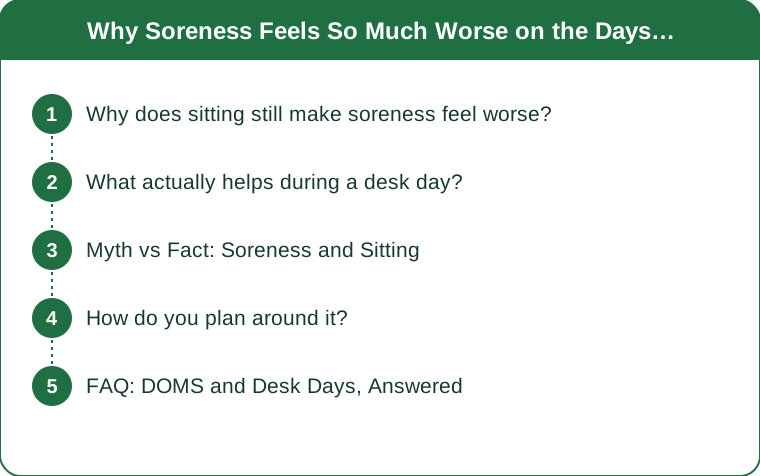
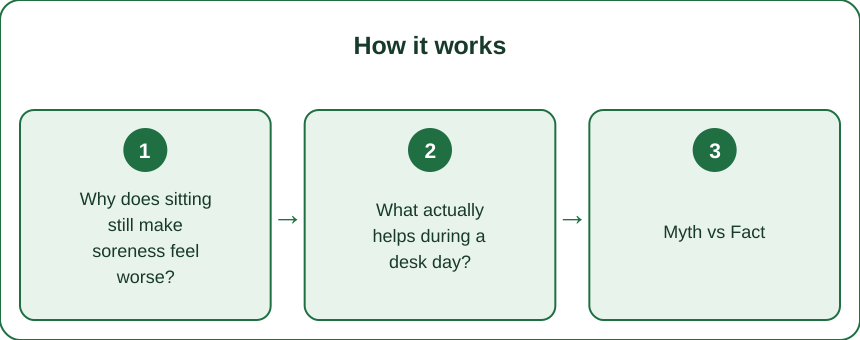
Why does sitting still make soreness feel worse?
Movement temporarily reduces the sensation of soreness. Gentle activity increases blood flow to the muscle and appears to reduce the perception of pain for a period afterwards. A day of errands delivers that repeatedly; a day at a desk delivers none of it.
Muscles sit shortened for hours. Sitting holds the hip flexors short and the hamstrings in a fixed position. Sore tissue held still in one position becomes noticeably stiffer than sore tissue that moves through range regularly.
The first movement after stillness is the worst moment. Stiffness after a long static period is a well-recognised pattern, and a desk day supplies eight separate opportunities to experience it.
Circulation drops when you are still. Muscle contraction assists blood return, so sitting reduces local circulation exactly when the tissue is recovering and would benefit from more.
Attention plays a genuine role. A day of errands provides constant distraction. A quiet desk with a repetitive task leaves plenty of attention available for a soreness signal that has not changed at all.
And desk days often follow the second night of sleep. DOMS typically peaks around 24 to 72 hours after training, and a Monday desk day frequently coincides with the peak of a weekend session rather than being caused by the desk itself.
What actually helps during a desk day?
Get up every thirty minutes, even for one minute. This is the highest-value intervention available and it costs nothing. A short walk to fill a glass of water counts.
Move through range rather than holding stretches. A few slow squats to a chair, some standing leg swings, or walking up a flight of stairs does more than a held hamstring stretch, and the evidence for static stretching reducing DOMS is weak.
Walk at lunch, even briefly. Ten to fifteen minutes of easy walking is enough to reduce the sensation for a useful part of the afternoon.
Change your sitting position periodically. Feet flat, then one leg extended, then standing. Varying the position prevents any single muscle group from staying shortened for the entire day.
Stay hydrated and eat normally. Neither cures soreness, but under-eating and under-drinking on a recovery day makes everything feel worse and delivers nothing useful in return.
And do not skip the next session purely because of stiffness. Training with mild soreness is generally fine, and light activity tends to reduce the sensation. Sharp, localised, or one-sided pain is a different matter - this is general information, not medical advice.

Myth vs Fact: Soreness and Sitting
Myth: Sitting still helps sore muscles recover. Fact: complete rest does not speed recovery, and gentle movement reduces the perceived soreness. Stillness mostly makes the experience worse without improving the outcome.
Myth: The soreness got worse during the day. Fact: the underlying process follows its own timeline. What changed is that you stopped moving, so the sensation became more noticeable at every transition.
Myth: Stretching at your desk will fix it. Fact: static stretching has limited evidence for reducing DOMS. Moving through range and walking are more effective uses of the same few minutes.
Myth: Soreness measures how good the workout was. Fact: soreness correlates poorly with training effect. Novel movements and eccentric work produce more of it regardless of how productive the session was.
Myth: A standing desk solves it. Fact: standing still all day creates its own problems, including leg swelling and foot discomfort. The benefit comes from changing position, not from standing continuously.
Myth: If it hurts this much you should skip the next session. Fact: mild to moderate soreness is not a reason to skip. Reduce load if needed, but light training often makes you feel better rather than worse.
How do you plan around it?
Put your hardest lower body session where the next day has movement in it. If Mondays are desk days, a Sunday leg session guarantees the worst possible combination. Shifting it to midweek can genuinely change the experience.
Introduce novel exercises gradually. DOMS is worst after unfamiliar movements and eccentric-heavy work. A big jump in either produces the kind of soreness that a desk day amplifies dramatically.
Schedule a walk into the calendar on the day after training. Treating it as an appointment rather than an intention is what makes it actually happen on a busy day.
Use the stairs on those days deliberately. Slow, controlled stairs are gentle range-of-motion work with a built-in reason to do them.
Expect the second day to be the worst. DOMS typically peaks somewhere between 24 and 72 hours, so plan the low-movement day for day three rather than day two if you have the choice.
And know that it improves with repetition. The repeated bout effect means the same session produces markedly less soreness the second and third time you do it, which is often within two or three weeks.
FAQ: DOMS and Desk Days, Answered
Why is my muscle soreness worse when I sit all day?
Because gentle movement temporarily reduces the sensation and increases blood flow, and a desk day removes it. Muscles also sit shortened for hours, so every time you stand up you get the stiffest possible first movement.
Should I rest completely when I am sore?
Generally no. Light activity tends to reduce the perceived soreness, and complete rest does not speed recovery. Reduce intensity rather than eliminating movement.
How often should I get up when I am sore at work?
Aim for a minute or two of movement every half hour, plus a ten to fifteen minute walk at lunch. Frequency matters more than duration here.
Does stretching at my desk help?
Moving through range - slow squats to a chair, leg swings, stairs - is more useful than held static stretches, which have limited evidence for reducing soreness.
TL;DR:
- Sitting still does not change the underlying soreness; it removes the gentle movement that reduces how it feels.
- Muscles held shortened for hours make every transition from sitting to standing the stiffest possible moment.
- Move for a minute every half hour and walk at lunch - frequency beats duration and beats static stretching.
- DOMS peaks roughly 24 to 72 hours after training, so schedule hard lower body sessions away from your least mobile day.
- Mild soreness is not a reason to skip training; sharp, localised, or one-sided pain is a different situation.
The desk did not make it worse. It just took away the thing that was quietly helping.
This is general information, not medical advice.
Keep Reading
This article is for general informational purposes only and is not medical advice. Always consult a qualified health professional for guidance specific to you.