Why Changing Only the Tempo Moves Your Soreness Around
Quick Answer: Soreness comes primarily from eccentric loading - the lengthening phase - and from muscle working at long lengths under tension. Slowing the lowering phase increases eccentric time under tension dramatically, which is why a 4-second descent produces far more soreness than a 1-second one at identical weight. Changing where in the range you spend time also shifts which muscle in a group takes the load.
The weight on the bar is a poor predictor of soreness. The time spent lengthening under load is a good one.

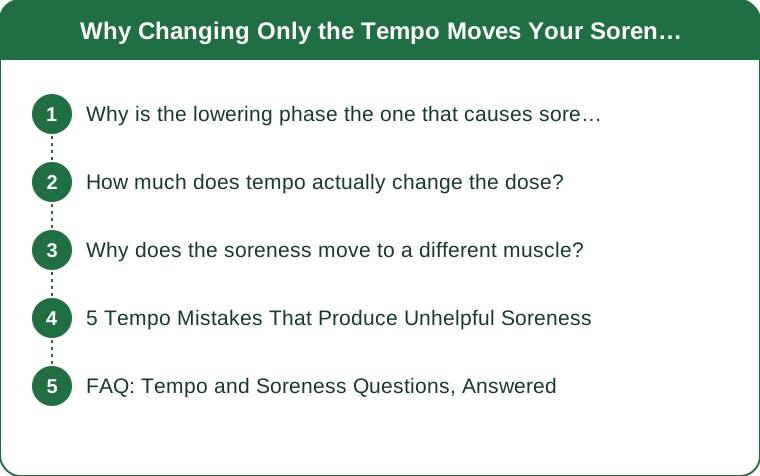
Why is the lowering phase the one that causes soreness?
Because eccentric contraction produces more mechanical stress per unit of muscle activation than concentric work does.
During an eccentric contraction the muscle produces force while lengthening. Fewer motor units are recruited to handle the same load - eccentric contractions can handle roughly 20 to 50 percent more force than concentric - which means the force per active fiber is considerably higher.
That higher per-fiber stress produces micro-disruption in the sarcomeres and the surrounding structures. The inflammatory and repair response to that disruption is what produces delayed onset muscle soreness, typically peaking 24 to 48 hours after training.
This is why the classic demonstration works: have someone walk down stairs repeatedly and they will be significantly sorer than someone who walked up the same number. The uphill group did more work. The downhill group did more eccentric work.
So when you slow a rep, you are not simply making it harder. You are specifically increasing the phase that drives soreness, which is a different thing from increasing the phase that drives adaptation, though they overlap substantially.
How much does tempo actually change the dose?
Enough that it is arguably a bigger variable than load for soreness purposes.
Compare two sets of 8 squats with the same weight. At a 1-second descent you accumulate 8 seconds of eccentric loading per set. At a 4-second descent you accumulate 32 seconds. That is a fourfold increase in the phase that causes soreness, with zero change in the weight.
Across three sets, that is 24 seconds versus 96 seconds. For a muscle unaccustomed to that duration, the difference in next-day soreness is dramatic - often the difference between mild stiffness and genuinely struggling with stairs.
There is also a fatigue interaction. Longer time under tension restricts blood flow for longer, producing more metabolic accumulation, which contributes to the immediate burning sensation and to some of the swelling.
The practical implication for programming: if you are introducing tempo work, reduce the load and the volume simultaneously. Adding a 4-second eccentric to your normal working weight and normal sets is a very large increase in stimulus, and the first session will produce soreness out of proportion to what you expected.
A reasonable entry point is dropping to around 60 to 70 percent of your usual load for the first two weeks of tempo work.

Why does the soreness move to a different muscle?
Because slowing down changes where in the range of motion you spend time, and different muscles in a group are loaded most at different joint angles.
Take a squat. The glutes are most loaded near the bottom, at deep hip flexion. The quadriceps take a larger share through the mid-range and near the top of the movement, particularly the vastus muscles.
A fast squat spends very little time at the bottom. A slow squat with a controlled descent spends several seconds approaching and passing through deep hip flexion - so the glutes get substantially more time under tension at their longest length.
Loading a muscle at long muscle lengths is a particularly strong stimulus both for soreness and for hypertrophy, which is one of the more consistent findings in recent training research.
The same logic applies elsewhere. A slow eccentric on a row loads the mid-back at a longer length. A slow lowering on a Romanian deadlift loads the hamstrings at their longest, which is why RDLs done slowly produce hamstring soreness far out of proportion to the weight used.
So when you slow a movement down and get sore somewhere new, that is not a technique error. It is the movement finally loading a muscle at a length it usually skips past.
5 Tempo Mistakes That Produce Unhelpful Soreness
-
Changing tempo and load in the same session. Two large variables at once means you learn nothing and are excessively sore. Change one.
-
Slowing the concentric instead of the eccentric. Slowing the lifting phase mostly reduces the weight you can use and adds fatigue without the eccentric stimulus. If you are going to slow one phase, slow the lowering.
-
Counting inconsistently. A 4-count that is actually 2 seconds on rep 1 and 4 seconds on rep 8 makes the whole prescription meaningless. Count out loud or use a timer for the first few sessions - most people’s internal count is substantially fast under load.
-
Applying tempo to everything at once. Tempo work across a full-body session produces soreness in everything simultaneously, which usually means the next two sessions are compromised. Apply it to one or two exercises.
-
Treating the resulting soreness as proof it worked. Soreness measures novelty and eccentric exposure, not effectiveness. A movement you have done for years at normal tempo may build more strength than a novel slow variation that leaves you wrecked.
The fifth one is the most consequential, because it drives people to chase soreness rather than progression.
FAQ: Tempo and Soreness Questions, Answered
Is more soreness a sign of a better workout?
No. Soreness correlates with unfamiliar eccentric load, not with growth or strength gain. Trained lifters progressing steadily often experience very little soreness. Using it as a scoreboard tends to push people toward constant novelty, which is worse for progression than consistency.
How long until tempo work stops making me sore?
Usually two to three sessions. The repeated bout effect is fast and robust - after one exposure, the same session produces substantially less damage and soreness. This is why the first tempo session is the worst by a wide margin.
Should I train a muscle that is still sore?
Mild soreness is fine to train through, and light activity often reduces it. Significant soreness that changes how you move is worth waiting out, because compensating movement patterns are where injuries come from. This is general information, not medical advice.
TL;DR:
- Eccentric loading drives soreness because fewer fibers handle more force per fiber during the lengthening phase.
- Slowing a descent from 1 second to 4 quadruples eccentric time under tension with no change in weight.
- Time spent at long muscle lengths shifts which muscle in a group takes the load - which is why soreness moves.
- Change tempo or load, not both, and start tempo work at roughly 60 to 70 percent of your usual weight.
- Soreness measures novelty, not effectiveness, and mostly disappears after two or three sessions.
If you want to know whether tempo is working, track the weight you can control for the prescribed count - not how sore you are. This is general information, not medical advice.
Keep Reading
This article is for general informational purposes only and is not medical advice. Always consult a qualified health professional for guidance specific to you.