How to Recover From Muscle Soreness (Ease the DOMS)
Quick Answer: DOMS relief comes from gentle movement, not rest. Light activity — a 15–20 minute walk, easy cycling, or the same exercise at 30–40% of your working weight — increases blood flow to sore tissue and reliably takes the edge off within an hour. Add sleep, protein, and hydration for the underlying repair. DOMS peaks 24–48 hours after training and clears on its own in 3–5 days.
You did legs on Monday. Tuesday you feel fine and think you got away with it. Wednesday morning you sit down on the toilet and audibly say “oh no.”
That’s DOMS — delayed onset muscle soreness — and the cruel joke of it is that the instinct it triggers (lie very still) is the exact opposite of what actually helps.

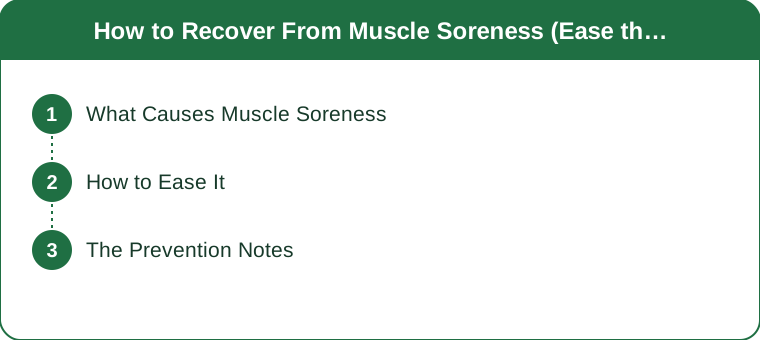
What causes DOMS?
Not lactic acid. That myth has outlived its evidence by about forty years — lactate clears from your bloodstream within roughly an hour of finishing a session, long before the soreness even arrives.
What actually happens is microscopic damage to muscle fibers and the connective tissue around them, followed by an inflammatory repair response. That response is what produces the tenderness, stiffness, and reduced range of motion. It’s a construction site, not an injury.
Three things reliably trigger it:
Eccentric loading. The lowering half of a rep — walking downhill, the descent of a squat, the negative on a curl. Eccentric work produces far more DOMS than concentric work at the same load.
Novelty. A movement your body hasn’t done recently, even at a modest weight. First tennis match of the summer, first hill run, first time doing lunges in a year.
A jump in volume or intensity. Adding 30% more sets than usual will do it even in a well-trained lifter.
Timeline: onset 12–24 hours after training, peak at 24–48 hours, resolution by 72–96 hours in most cases.

What’s the best thing for DOMS relief?
Gentle movement, first and best. 15–20 minutes of easy walking, cycling, or swimming. Or “active recovery” on the sore movement itself: 2 sets of 10–15 reps at 30–40% of your working weight. Blood flow through the tissue is the mechanism, and the relief usually lasts several hours.
Sleep. 7–9 hours. Most of the actual repair work — growth hormone release, protein synthesis — happens during deep sleep. Nothing on this list beats it.
Protein and total calories. Roughly 1.6–2.2 g of protein per kg of bodyweight per day supports repair. A 70 kg person is looking at 110–155 g. Repair also requires energy, so a hard-training week in a steep deficit will leave you sore longer.
Hydration. Dehydrated muscle tissue feels worse and recovers slower. Nothing exotic — just don’t finish the day at half a liter.
Heat, once the peak passes. A warm bath or shower on day 2–3 loosens stiffness. Comfort-driven, and comfort is a legitimate goal here.
Foam rolling and massage. The research shows modest but real reductions in perceived soreness. 60–90 seconds per muscle group. Uncomfortable, not agonizing — if you’re holding your breath, ease off.
Time. Underrated. Nothing on this list eliminates DOMS; everything on it makes the 3–5 days more livable.
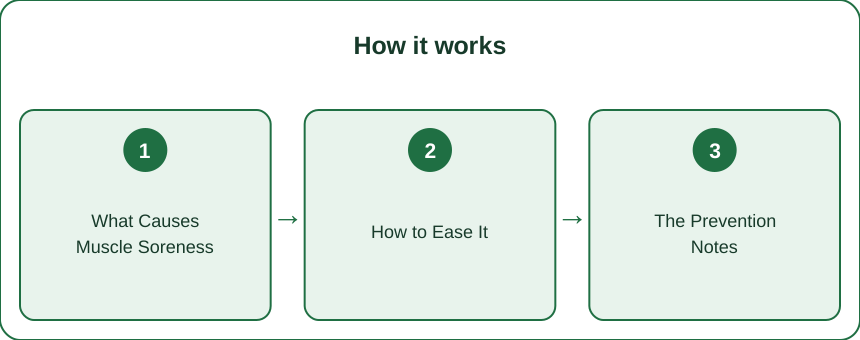
Myth vs Fact
Myth: Lactic acid causes DOMS. Fact: Lactate is cleared within about an hour post-exercise. DOMS is muscle-fiber microdamage and the inflammatory repair response, arriving a full day later.
Myth: Soreness means it was a good workout. Fact: Soreness tracks novelty and eccentric load, not training quality. An experienced lifter running a well-designed program is often not sore at all while making steady progress. Chasing soreness is chasing the wrong number.
Myth: You should rest completely until it’s gone. Fact: Complete rest tends to prolong the stiff, achy feeling. Light movement is the most reliable relief on this entire page.
Myth: Stretching before a workout prevents DOMS. Fact: Static stretching pre-workout doesn’t meaningfully prevent DOMS. A proper warm-up and gradual progression do.
Myth: No soreness means you wasted the session. Fact: Your muscles adapt. The repeated bout effect means the same workout produces dramatically less soreness the second and third time — that’s adaptation working, not effort declining.
How do you prevent DOMS next time?
Progress gradually. The workable guideline is roughly 10% more volume or load per week, not 40%. Most brutal DOMS episodes are a programming error, not a toughness achievement.
Warm up properly. 5–10 minutes of general movement plus 2–3 progressively heavier ramp-up sets before your working weight.
Ease into anything new. First session with a new exercise: 2 sets instead of 4, and stop noticeably short of failure. You’ll still get the adaptation, at about a third of the soreness cost.
Train it again. The repeated bout effect is remarkably strong — repeat the same session within 1–2 weeks and the soreness drops sharply. Consistency is the real prevention.
Cool down. 5 minutes of easy movement after the session, not a hard stop from your last set to the car.
When to see a professional
Most DOMS is fine. See a clinician if soreness is severe and disproportionate to what you did, if it lasts beyond about 7 days, if a joint is swollen or you have sharp localized pain rather than diffuse muscle ache, or if you notice unusually dark or cola-colored urine along with severe soreness and weakness — that last combination warrants prompt medical attention.
FAQ
How long does DOMS last?
Typically 3–5 days, with the peak at 24–48 hours after training. A first-ever session or a very heavy eccentric workout can stretch it to about 7 days. Anything longer than that is worth a check-in.
Should you work out with sore muscles?
Yes, usually — just train something else, or train the sore muscle lightly. Sore legs are a fine day for upper body. What you shouldn’t do is a heavy, high-intensity session on a severely sore muscle group, since compromised force output raises injury risk.
Do ice baths help with DOMS?
Cold water immersion does reduce perceived soreness in the short term. The tradeoff: regularly icing after strength training may blunt some of the muscle-building adaptations you’re training for. Reasonable during a competition week, questionable as a year-round habit after every lift.
TL;DR:
- DOMS is microdamage plus inflammatory repair — not lactic acid, which clears within an hour.
- Peaks at 24–48 hours, resolves in 3–5 days.
- Gentle movement is the single most reliable relief: 15–20 minutes easy, or 2 sets at 30–40% load.
- Sleep 7–9 hours, hit 1.6–2.2 g protein per kg, stay hydrated — that’s the actual repair work.
- Soreness is not a scoreboard; well-programmed training often produces very little.
- Prevent it by progressing ~10% a week, warming up properly, and easing into anything new.
- Severe soreness with dark urine and weakness needs prompt medical attention.
Keep Reading
This article is for general informational purposes only and is not medical advice. Always consult a qualified health professional for guidance specific to you.