DOMS or Something Worse? The Difference Most People Miss Until It's Too Late
Quick Answer: Normal DOMS (delayed onset muscle soreness) builds gradually over 24-48 hours, feels like dull, symmetric aching across a muscle group, and improves with gentle movement — an injury typically causes sharper, localized pain at the moment it happens or shortly after, worsens with movement, and often comes with swelling or a specific pinpoint location, not a broad muscle area.
Getting this distinction right matters, because pushing through what’s actually an injury (mistaking it for “just soreness”) is how minor issues become much bigger ones.

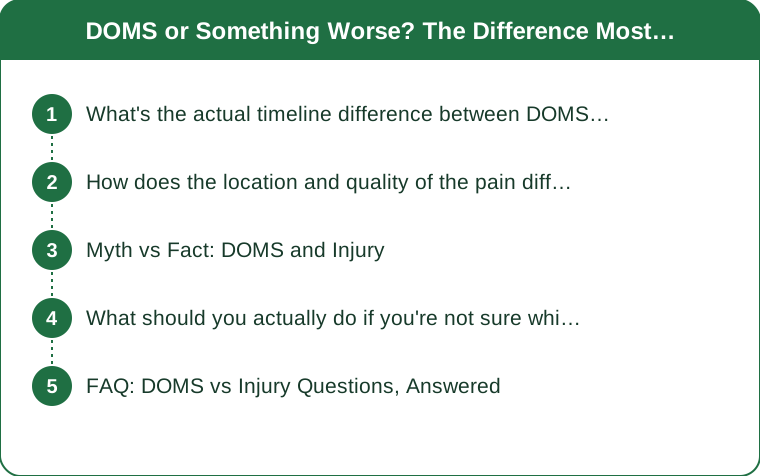
What’s the actual timeline difference between DOMS and an injury?
DOMS builds over 24-48 hours after a workout, typically peaking on day two, then gradually easing over the following days. Injury pain, by contrast, is usually noticeable either immediately during the activity or within a few hours, not building slowly over two full days — and it doesn’t follow the same predictable rise-and-fall pattern.
If pain shows up mid-set or immediately after a specific movement, that’s a very different pattern than the general next-day ache of DOMS.
How does the location and quality of the pain differ?
DOMS tends to be diffuse and symmetric — both quads ache similarly after leg day, for example — and feels like a dull, generalized soreness rather than a sharp point. An injury is more often localized to a specific spot (one particular point in the muscle, a joint, or a tendon), and the pain quality is typically sharper, and worsens rather than improves with movement.
Swelling, bruising, or a visible change in the area is essentially never a DOMS symptom and should always be treated as a possible injury signal.

Myth vs Fact: DOMS and Injury
Myth: If it hurts more the next day, it must be an injury. Fact: DOMS classically peaks on day two, not day one — worsening slightly the day after is actually the normal DOMS pattern, not a red flag by itself.
Myth: You should always push through muscle pain to “work it out.” Fact: Gentle movement helps genuine DOMS, but pushing through sharp, localized, or worsening pain is exactly how a minor strain becomes a more serious injury.
Myth: Soreness that lasts more than a week is always cause for concern. Fact: It depends on intensity relative to your training history — a completely new type of exercise can cause DOMS lasting up to a week, though pain persisting well beyond that is worth checking.
What should you actually do if you’re not sure which one it is?
If the pain is diffuse, symmetric, gradually building, and improves with light movement — treat it as DOMS: light activity, hydration, and time. If it’s sharp, localized to one spot, present during or immediately after the activity, or comes with swelling/bruising — stop the activity and treat it as a potential injury, which means rest and, if it doesn’t improve within a few days, a professional evaluation.
When genuinely unsure, erring toward caution (resting the area for 48-72 hours) costs very little and avoids the risk of worsening an actual injury.
FAQ: DOMS vs Injury Questions, Answered
Can DOMS and a minor injury happen from the same workout?
Yes — it’s possible to have general DOMS across a muscle group while also having a specific, sharper injury point within that same area, which is part of why location and pain quality matter more than just timing alone.
Does foam rolling help tell the difference?
Not really as a diagnostic tool, but foam rolling that clearly worsens a specific sharp point (versus generally easing broad soreness) is itself a useful signal that something beyond normal DOMS may be present.
Should you train through DOMS the next day?
Light to moderate movement is generally fine and can even help DOMS resolve faster, but high-intensity training on the same heavily fatigued muscle group is best avoided until soreness meaningfully eases.
TL;DR:
- DOMS builds gradually over 24-48 hours and feels diffuse, symmetric, dull
- Injury pain is often immediate or near-immediate, sharp, and localized
- Swelling or bruising point toward injury, not normal DOMS
- When unsure, resting the area 48-72 hours is a low-cost, safer default
This is general information, not medical advice — persistent or worsening pain deserves a professional evaluation rather than guesswork.
Keep Reading
This article is for general informational purposes only and is not medical advice. Always consult a qualified health professional for guidance specific to you.