DOMS or Injury? How to Tell the Difference Before You Train Again
Quick Answer: DOMS is diffuse, symmetrical, arrives 24 to 48 hours after unfamiliar effort, feels like a dull ache that eases as you warm up, and resolves within about five days. Injury is usually one-sided and specific, often traceable to a single moment, sharp or stabbing with certain movements, and it gets worse with activity rather than better. The gray zone gets a protocol: 48 hours of easy movement, the improving-during-warm-up test, and a hard rule - anything sharp, swelling, joint-located, or still worsening after five to seven days gets assessed by a professional.
Every training life includes the morning-after audit: something hurts, and the next decision matters. Call an injury mere soreness and you can turn a two-week problem into a two-month one; call normal DOMS an injury and you lose training weeks to fear. The two states feel confusingly similar on day one - and helpfully, they follow completely different scripts from there. Learning both scripts is one of the most valuable skills in fitness.

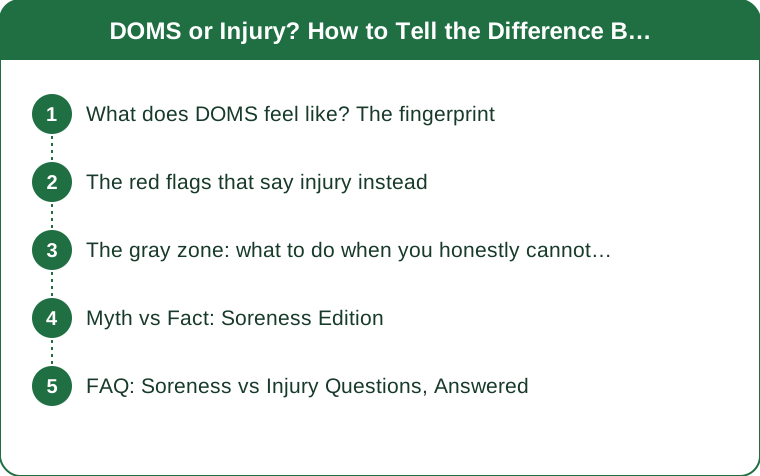
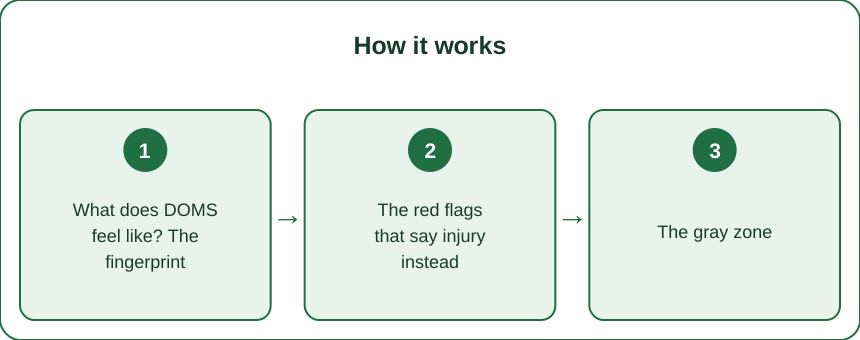
What does DOMS feel like? The fingerprint
Delayed onset muscle soreness has a signature so consistent you can almost use it as a checklist.
It is delayed - that is the D. The soreness arrives 24 to 48 hours after the session, typically peaking around the second day, which is why Tuesday’s leg day reads fine Wednesday morning and writes poetry on Thursday. Discomfort that begins during the workout or within the hour after is, by definition, not DOMS - file that fact away, because it is the cleanest dividing line available.
It is diffuse and regional. DOMS occupies the whole muscle or muscle group - the entire quad, both sides of the chest, the full sweep of the glutes - rather than one findable point. Press around: DOMS is tender everywhere in the neighborhood, roughly evenly. You cannot put one fingertip on it.
It is usually symmetrical. Both legs squatted, so both quads complain, in roughly equal voice. Meaningfully one-sided soreness after a symmetrical workout deserves suspicion - not panic, but suspicion.
It matches the work you did. DOMS shows up in the muscles the session targeted, scaled to how novel the stimulus was - new exercises, returning after a break, extra emphasis on the lowering phase. Soreness in a place the workout barely involved does not fit the fingerprint.
It behaves characteristically: stiff and achy at rest, worst on first movement - the sit-to-stand groan, the staircase descent - then genuinely easing as you move and warm up, returning after long stillness. It is a dull, spread-out, movement-shy ache, never electric.
And it resolves on schedule. Noticeable improvement by day three or four, essentially gone by day five - a week at the outside after something truly novel. DOMS has a story arc. Pain that ignores the arc is telling a different story.
The red flags that say injury instead
Injury announces itself differently. Any one of these moves you out of the soreness column:
A moment. You can name the rep, the step, the twist - something happened, possibly with a sensation of pulling, popping, or giving way, and the pain dates from that instant. DOMS never has a timestamp; injuries usually do.
Sharp, stabbing, or electric quality. DOMS aches; injury bites. Pain that is sharp on specific movements - a lunge angle, a reach, a single stair - especially pain that stops you mid-movement, is structural until proven otherwise. Numbness, tingling, or pain shooting down a limb belongs to the nerve category and skips the gray zone entirely: that gets assessed.
One precise location. If one fingertip finds the spot - a point on the tendon, a spot deep in the joint line, one rib of muscle near its attachment - that specificity is meaningful. Extra suspicion when the spot is at a joint or where muscle becomes tendon, which are injury neighborhoods, not DOMS neighborhoods.
Swelling, bruising, warmth, or visible change. DOMS can make a muscle feel full, but visible swelling, discoloration, or a warm spot indicates tissue damage with inflammation to show for it. Compare sides in a mirror; asymmetry you can see outranks anything you feel.
Wrong-direction trajectory. Injury tends to worsen with continued activity and often aches at rest or at night - pain that wakes you, or that hurts as much on day four as day one, has exited the DOMS script. Likewise weakness beyond soreness: a limb that cannot produce force, buckles, or will not bear weight is reporting damage, not fatigue.
The pattern to memorize: DOMS improves as you move and resolves across days; injury sharpens with use and persists. When the story includes a moment, a point, a joint, swelling, real weakness, or nerve sensations - stop self-diagnosing and get eyes on it. This is general information, not medical advice; when in doubt, a clinician beats a checklist.

The gray zone: what to do when you honestly cannot tell
Plenty of mornings sit between the columns - soreness that is a bit one-sided, an ache near a joint, day three with limited improvement. The gray zone gets a protocol, not a guess.
Step 1: 48 hours of easy movement, not rest and not testing. Full couch rest helps neither condition, and re-testing the painful movement daily irritates whatever is there. Instead: walking, gentle cycling, easy mobility work, and light activity for unaffected areas. Movement is diagnostic - DOMS reliably feels better after ten minutes of easy circulation; injuries typically do not.
Step 2: the warm-up test, run once daily. Begin a very light version of activity involving the area - bodyweight only, half range, unhurried. Apply the rule: discomfort at three out of ten or below that fades as you warm up is generally acceptable territory; anything sharp, anything above that line, or anything intensifying as you continue means stop for today. Improving-with-warmth is the DOMS signature; sharpening-with-load is the injury signature, and the test surfaces which one you have without a maximal effort.
Step 3: train around, never through. While the question is open, the rest of the body remains open for business - upper body while a leg question resolves, legs while a shoulder question resolves. Isometrics - gentle held contractions with no movement - are often comfortable even when a muscle is unhappy and keep the area engaged without the strain of full reps. What stays off the menu: max loads, explosive work, and the exact movement that provokes the symptom.
Step 4: enforce the deadline. DOMS resolves; that is its defining courtesy. If day five arrives without clear improvement - or anything worsens along the way - the experiment ends and assessment begins. A physio or sports-medicine visit at day five for what turns out to be nothing costs you a copay and an afternoon. The same visit at week six for what turned out to be something costs you a season. The math has never once favored waiting.
And log it in your training notes - one line: what hurt, when it started, what it responded to. Patterns across months (the same knee, always after the same movement) are the early-warning system no single morning can provide.
Myth vs Fact: Soreness Edition
Myth: No pain, no gain - soreness proves the workout worked. Fact: DOMS mainly measures novelty, not productivity. It spikes with new movements and eccentric emphasis, then fades as you adapt - even while the same training keeps building strength and muscle. Chasing soreness as a scorecard leads to program-hopping and permanently trashed legs, not faster progress.
Myth: If you can walk it off, it is not an injury. Fact: Plenty of real injuries - tendinopathies, minor strains, stress reactions - warm up enough to train through, then bill you afterward with interest. The full test is the whole pattern: what it feels like at rest, during, after, and the trajectory across days. Warming up quiet is one data point, not an acquittal.
Myth: Stretching prevents and cures DOMS. Fact: The research is consistently unimpressed - stretching before or after exercise changes soreness barely if at all. Gentle stretching can feel good during DOMS, which is a fine reason to do it; expecting it to prevent or erase soreness sets up disappointment. The actual preventer is progressing new stimulus gradually.
Myth: Really bad DOMS is just DOMS - wait it out. Fact: Extreme, disproportionate soreness with significant swelling or very dark urine after an unusually brutal session is the calling card of rhabdomyolysis - rare, serious, and a same-day medical situation, not a foam-rolling situation. Soreness so severe you cannot perform basic movements deserves a professional opinion regardless.
Myth: Pushing through pain builds toughness. Fact: Pushing through DOMS is fine and sometimes even helpful; pushing through injury converts small problems into long ones. The skill worth building is not tolerance - it is telling the two apart, which is precisely why this article exists.
FAQ: Soreness vs Injury Questions, Answered
Can I work out with DOMS?
Yes - light-to-moderate activity is generally fine and often eases the ache; blood flow is the best DOMS medicine available. Sensible adjustments: expect reduced strength in the sore muscles, favor different muscle groups for hard work, and skip maximal or explosive efforts until the soreness clears. Training through DOMS occasionally is normal; needing to every week means the program is over-novel.
Why is day two worse than day one?
The soreness follows the inflammatory and repair timeline of the micro-damage from unfamiliar exercise, which builds over 24 to 48 hours before receding - so the peak lands on the second morning. It is expected, temporary, and not a sign things are deteriorating; deterioration continuing past day three is what breaks the pattern.
Do massage guns and foam rolling help - or hide an injury?
They modestly help DOMS comfort and are pleasant enough to justify themselves. The caution is real, though: numbing a specific painful spot enough to train hard on it is how gray-zone injuries get worse with a clear conscience. Use tools on diffuse soreness freely; treat one-spot pain as information, not a target.
When exactly should I see someone about post-workout pain?
Immediately for: pain from a specific moment with swelling or bruising, joint pain, numbness or tingling, inability to bear weight, or severe soreness with dark urine. On a five-to-seven-day deadline for: anything one-sided and specific that is not clearly improving. The visit is cheap, the delay is not - that asymmetry should make the decision every time.
TL;DR:
- DOMS: delayed, diffuse, symmetrical, matches the workout, eases with movement, gone in about five days.
- Injury: a nameable moment, sharp quality, one findable spot, often at a joint - and it worsens with use.
- Automatic assessment triggers: swelling, bruising, numbness, real weakness, night pain, or a joint location.
- Gray zone: 48 hours of easy movement, the three-out-of-ten warm-up rule, train around it, and a hard day-five deadline.
- Soreness measures novelty, not progress - never chase it, never fear it.
Your body files two very different kinds of reports, in similar envelopes. Learn to read the postmark and the handwriting, and you will spend your training years interrupted by neither false alarms nor ignored ones.
Keep Reading
This article is for general informational purposes only and is not medical advice. Always consult a qualified health professional for guidance specific to you.