When Muscle Soreness Feels Worse Than Usual: Normal DOMS or Something Else?
Quick Answer: Typical DOMS is a dull, symmetric ache that peaks 24-72 hours after exercise and gradually improves, while soreness that’s sharp, one-sided, accompanied by significant swelling, or doesn’t improve after several days falls outside the normal DOMS pattern and is worth having evaluated rather than assumed to be routine soreness.
Most post-workout soreness is nothing to worry about. But some soreness patterns genuinely fall outside typical DOMS, and it’s worth knowing the difference.

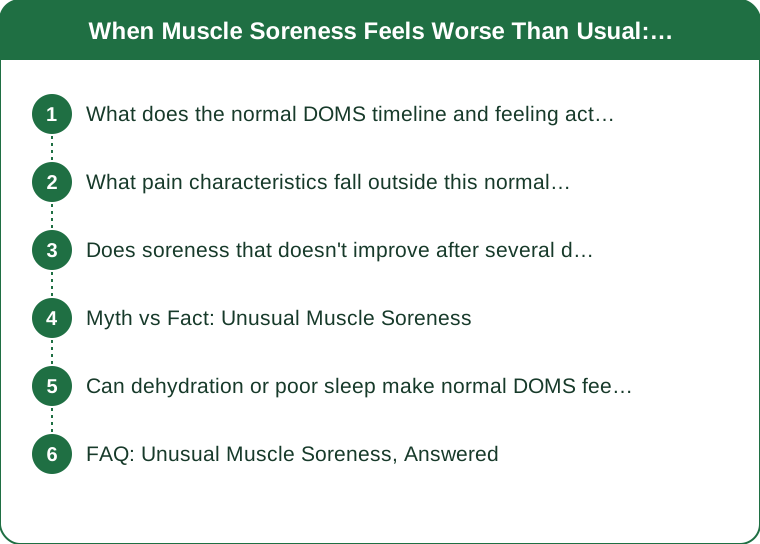
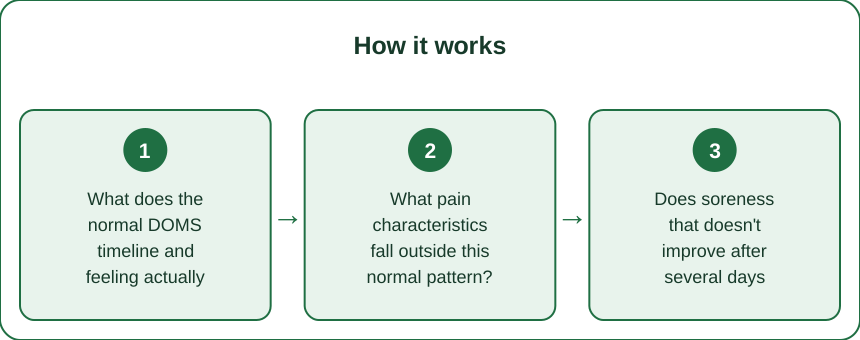
What does the normal DOMS timeline and feeling actually look like?
Typical DOMS presents as a dull, diffuse ache that develops 12-24 hours after unfamiliar or intense exercise, peaks around 24-72 hours, and gradually resolves within about a week. It’s usually symmetric if both sides of the body did similar work, and it tends to improve, not worsen, with gentle movement.
What pain characteristics fall outside this normal pattern?
Sharp, localized pain rather than a diffuse ache, pain that’s significantly worse on one side despite symmetric exercise, or pain accompanied by noticeable swelling, bruising, or reduced range of motion are patterns that suggest something beyond typical DOMS, potentially a strain or other injury that warrants evaluation rather than just resting through it.
Does soreness that doesn’t improve after several days indicate a problem?
Yes — typical DOMS reliably improves within about a week even without specific treatment, so soreness that persists well beyond that window, or that worsens rather than gradually improves, is outside the normal DOMS pattern and worth discussing with a healthcare provider rather than continuing to wait it out.

Myth vs Fact: Unusual Muscle Soreness
Myth: All post-workout muscle pain is DOMS and will resolve on its own. Fact: Some pain patterns, particularly sharp or one-sided pain with swelling, indicate an injury rather than typical DOMS and need different handling.
Myth: Worse soreness always means you had a more effective workout. Fact: Soreness intensity doesn’t reliably correlate with workout effectiveness — it more often reflects how unfamiliar the movement was to your muscles.
Can dehydration or poor sleep make normal DOMS feel unusually intense?
Yes — inadequate hydration, poor sleep, and high stress levels can all amplify how intense normal DOMS feels without changing the underlying pattern, meaning unusually intense but still-typical DOMS (diffuse, symmetric, resolving within a week) may simply reflect these recovery factors rather than a new injury.
FAQ: Unusual Muscle Soreness, Answered
Should you keep exercising through soreness that seems outside the normal DOMS pattern?
No — continuing to train through pain that doesn’t fit typical DOMS risks worsening a potential injury; it’s better to rest and evaluate first.
Does icing or heat help distinguish DOMS from an injury?
Not reliably — the pain pattern itself (location, symmetry, timeline) is a better indicator than response to icing or heat.
When should unusual soreness prompt an actual medical visit rather than waiting?
Sharp pain, significant swelling, inability to bear weight or use the muscle normally, or pain persisting beyond a week all warrant a professional evaluation. This is general information, not medical advice.
TL;DR:
- Normal DOMS is a dull, symmetric ache peaking 24-72 hours after exercise and resolving within a week
- Sharp, one-sided pain or pain with swelling falls outside typical DOMS
- Soreness that doesn’t improve after a week is worth having evaluated
- Poor sleep and dehydration can intensify normal DOMS without changing its underlying pattern
If soreness feels different from your usual post-workout ache — sharper, one-sided, or lingering — treat that as a signal to check in with a professional rather than push through.
Keep Reading
This article is for general informational purposes only and is not medical advice. Always consult a qualified health professional for guidance specific to you.