Does What You Eat After a Workout Actually Reduce DOMS? Here's What Holds Up
Quick Answer: Adequate post-workout protein intake (roughly 20-40g within a few hours) and staying well-hydrated have the most consistent evidence for modestly reducing DOMS severity, while claims about specific ‘anti-inflammatory’ foods eliminating soreness are generally overstated — nutrition helps at the margins, it doesn’t prevent DOMS outright.
Tart cherry juice, turmeric, specific supplement stacks — post-workout soreness content promises a lot, and it’s worth separating what’s modestly supported from what’s mostly marketing.

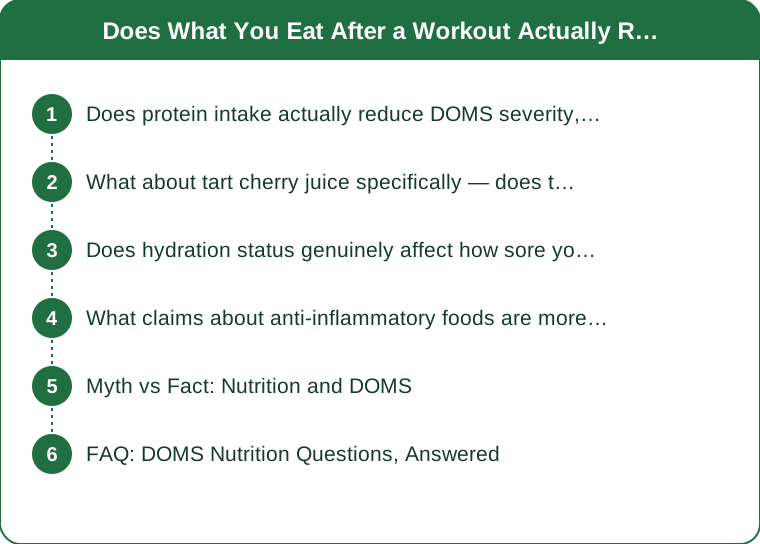
Does protein intake actually reduce DOMS severity, or just support muscle repair generally?
Both, to some extent — adequate protein intake supports the muscle repair process that underlies DOMS resolution, and some research specifically shows slightly reduced soreness severity and faster strength recovery with sufficient post-workout protein (roughly 20-40g) compared to inadequate intake, though it doesn’t eliminate soreness entirely.
What about tart cherry juice specifically — does the popular claim hold up?
Tart cherry juice has some research support for modestly reducing DOMS severity and inflammatory markers, likely related to its anthocyanin content, though effect sizes in studies are generally modest rather than dramatic — it’s a reasonable addition, not a soreness-eliminating solution on its own.
Does hydration status genuinely affect how sore you get?
Yes, to a meaningful degree — dehydration is associated with worse perceived muscle soreness and slower recovery in several studies, likely related to impaired nutrient delivery and waste clearance in under-hydrated tissue, making hydration one of the more solidly supported nutrition factors here.

What claims about anti-inflammatory foods are more overstated than supported?
Blanket claims that specific single foods (turmeric, ginger, a particular ‘anti-inflammatory’ smoothie) meaningfully prevent or eliminate DOMS generally outpace the actual evidence, which tends to show small, inconsistent effects at best for isolated foods compared to the more consistently supported basics of adequate protein and hydration.
Myth vs Fact: Nutrition and DOMS
Myth: The right post-workout meal can prevent DOMS entirely. Fact: nutrition can modestly reduce severity and support faster recovery, but DOMS from genuinely unfamiliar or intense training happens regardless of diet quality.
Myth: Anti-inflammatory supplements are all equally well-supported. Fact: evidence quality varies a lot — tart cherry juice has more research behind it than many trendy single-ingredient claims.
Myth: More protein always means less soreness. Fact: protein helps up to an adequate intake level; consuming far beyond that doesn’t produce additional soreness-reduction benefit.
FAQ: DOMS Nutrition Questions, Answered
How soon after a workout does post-workout nutrition need to happen to matter for DOMS?
While the old ‘anabolic window’ idea has been relaxed somewhat, eating protein within a few hours post-workout (rather than skipping the meal entirely) is still a reasonable, evidence-supported target.
Are omega-3 fatty acids worth adding specifically for soreness?
Some research suggests omega-3s may modestly support reduced inflammation and soreness with regular intake over time, though the effect is more about consistent intake than a single post-workout dose.
Does carbohydrate intake matter for DOMS the way protein does?
Carbohydrates support glycogen replenishment, which matters for overall recovery and next-session performance, but the direct evidence connecting carb intake specifically to reduced DOMS severity is weaker than for protein and hydration.
TL;DR:
- Adequate post-workout protein (20-40g) and good hydration have the most consistent evidence for modestly reducing DOMS
- Tart cherry juice has real, if modest, research support — more than most single-ingredient anti-inflammatory claims
- Blanket claims that specific foods prevent DOMS entirely generally outpace the actual evidence
- Nutrition helps at the margins; it doesn’t eliminate soreness from genuinely intense or unfamiliar training
Focus your post-workout nutrition on protein and hydration basics before chasing trendy single-ingredient fixes. This is general information, not medical advice.
Keep Reading
This article is for general informational purposes only and is not medical advice. Always consult a qualified health professional for guidance specific to you.