Why Muscle Soreness Sometimes Hits Only One Side of Your Body After a Symmetrical Workout
Quick Answer: One-sided soreness after a workout you thought was perfectly even is normal and usually harmless. Your dominant side quietly takes more of the load, small strength or mobility differences change how an identical weight actually lands, and setup asymmetries you never noticed shift the work. Pay closer attention only if it’s sharp pain rather than dull ache, dramatically worse on one side, happening across every workout type, or paired with swelling or numbness. This is general information, not medical advice.
You did a barbell squat. Two legs. Same bar. Same reps.
Two days later, your right quad feels like it lost a fight and your left one is basically fine.
Nothing went wrong. Your body just isn’t the symmetrical machine the exercise assumed it was.

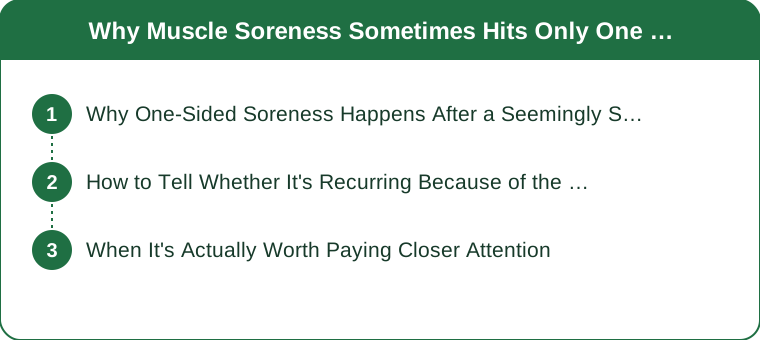
Why Am I Only Sore On One Side After a Symmetrical Workout?
Four ordinary explanations cover almost every case.
Your dominant side does more work — even when it isn’t supposed to. Motor dominance doesn’t switch off because an exercise is technically bilateral. During a squat, press, or row, the dominant side often quietly contributes more force. You don’t feel it happening. You feel it 36 hours later.
Small existing asymmetries change where the load actually goes. Almost nobody has identical strength, flexibility, and mobility on both sides. If your right hip has 10 degrees more rotation than your left, an identical external load produces genuinely different internal stress. Same bar, different job.
Your setup was slightly uneven and you didn’t notice. Foot placement half an inch off. Grip a touch wider on one side. Weight sitting more on one heel. These are nearly invisible in the moment and completely real in their effect on load distribution. Film one set from the front sometime — it’s humbling.
New movements recruit stabilizers unevenly. When a movement pattern is unfamiliar, one side’s stabilizing muscles tend to pick up more of the balancing work. This is the most self-correcting cause on the list: it usually evens out within a few weeks of practice.
None of these mean something unusual happened. They mean the workout was symmetrical and you aren’t.

Is It a One-Off or an Actual Pattern?
Worth knowing the difference, because the answers are different.
Check whether it’s the same side across different workout types. If your right side is sorer after upper-body days, lower-body days, and a completely unrelated movement, that points toward a real underlying asymmetry rather than per-workout randomness. One workout means nothing. Six workouts across three movement categories means something.
Check whether it matches your dominant hand or leg. If the consistently sorer side is your dominant side, you’ve probably found your explanation — and it’s the benign one. Dominant-side overuse is common and rarely a problem in itself.
Mention a fixed pattern to a trainer or PT, even with no pain. This is the part people skip. A consistent asymmetry is useful information for a coach or physical therapist even when nothing hurts. It might change your exercise selection, your cueing, or nothing at all — but it’s worth the thirty seconds it takes to say.
A practical way to log it: after each session, note which side felt worse on a 1–10 scale. Six sessions of data tells you more than any amount of guessing.
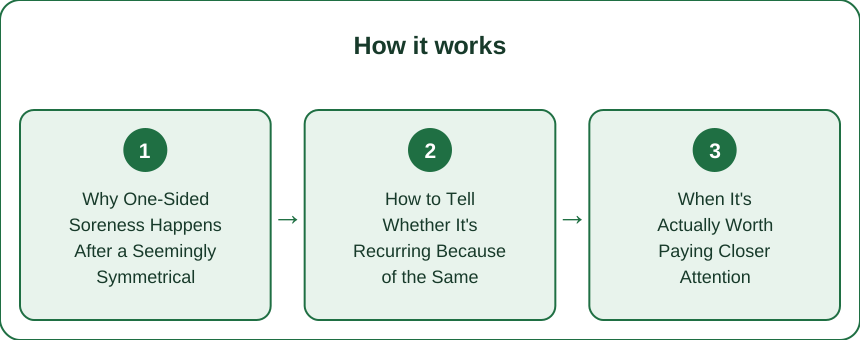
Myth vs Fact
Myth: More soreness on one side means that side worked harder, so it’s getting stronger faster. Fact: Soreness is a poor proxy for training stimulus generally, and worse than usual here. A side can be sorer because it was less prepared, more novel to the movement, or slightly overstretched — none of which mean more productive work happened.
Myth: You should train the sorer side less until it catches up. Fact: That’s backwards in most cases. If anything, the weaker side benefits from dedicated unilateral work — single-leg or single-arm variations — so it stops relying on its neighbor. Cutting volume on the sorer side often widens the gap.
Myth: Asymmetry means you’re injured. Fact: Some degree of side-to-side difference is present in essentially everyone. The threshold that matters isn’t “is there a difference” — it’s the specific signs in the next section.
When Should I Actually Be Concerned?
Four signals move this out of the ordinary category:
Dramatically more severe, not just mildly more noticeable. A right side that’s a 6/10 and a left that’s a 4/10 is normal variation. A 9 and a 1 is a different conversation.
Sharp, localized pain instead of dull, diffuse ache. Ordinary delayed-onset soreness is spread out and achy — it hurts across a whole muscle belly and eases as you move around. Sharp pain you can point to with one finger, especially pain that worsens with movement rather than easing, has a different character and deserves attention.
A persistent cross-exercise pattern. Not one workout — the same side, every time, across totally different movements, for weeks.
Swelling, numbness, tingling, or real loss of range of motion. These aren’t soreness symptoms at all. They belong to a different category and shouldn’t be waited out.
When to see a professional: if you have any of the four above, if soreness lasts beyond 5–7 days without improving, or if you notice a visible size difference between sides, see a physical therapist or your provider. Severe one-sided pain with dark urine after intense exercise is a medical emergency — go in immediately. This is general information, not medical advice.
Mini FAQ
How long should one-sided DOMS last?
Same as ordinary soreness — peaking around 24–48 hours and largely resolved by day 3 to 5. If one side is still meaningfully sore at day 7 while the other cleared on schedule, that’s worth a look.
Should I stretch the sorer side more?
Gentle movement helps both sides equally; aggressive stretching of an already-sore muscle doesn’t speed anything up and can irritate it. Light activity, adequate protein, and sleep do more than any stretching protocol.
Can I fix the underlying asymmetry?
Often, partially. Unilateral work — single-leg squats, single-arm presses, suitcase carries — makes each side do its own job without help. Give it 8–12 weeks. Some asymmetry is structural and won’t change, and that’s fine; the goal is functional balance, not perfect symmetry.
TL;DR:
- Dominant-side dominance, existing asymmetries, unnoticed setup unevenness, and movement novelty explain most one-sided soreness.
- Track which side across 6 sessions to tell a pattern from a one-off.
- Soreness is a bad measure of how hard a side worked — don’t train around it.
- Unilateral exercises are the fix for a real asymmetry, not reduced volume.
- Concerning: sharp localized pain, dramatic severity gap, swelling/numbness, or soreness past 5–7 days. See a professional.
Keep Reading
This article is for general informational purposes only and is not medical advice. Always consult a qualified health professional for guidance specific to you.