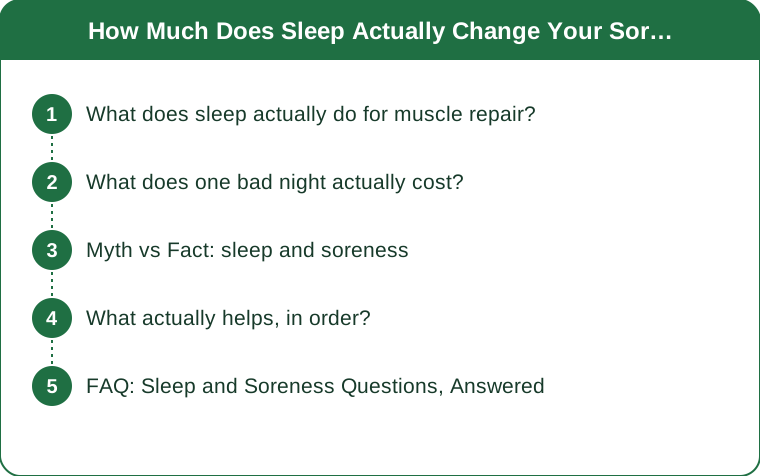
How Much Does Sleep Actually Change Your Soreness? More Than You Would Guess
Quick Answer: Sleep affects soreness more than any recovery product you can buy. A single night under six hours measurably raises perceived soreness and inflammatory markers the following day, and chronic short sleep slows the repair of exercise-induced muscle damage. The two highest-value changes are consistent timing and protecting the first three hours of sleep, when most growth hormone release occurs.
People spend money on massage guns, compression boots and recovery drinks, all of which have modest evidence behind them, and then sleep six hours a night.
The honest hierarchy of recovery interventions puts sleep at the top by a wide margin, and it is the only one that is free.
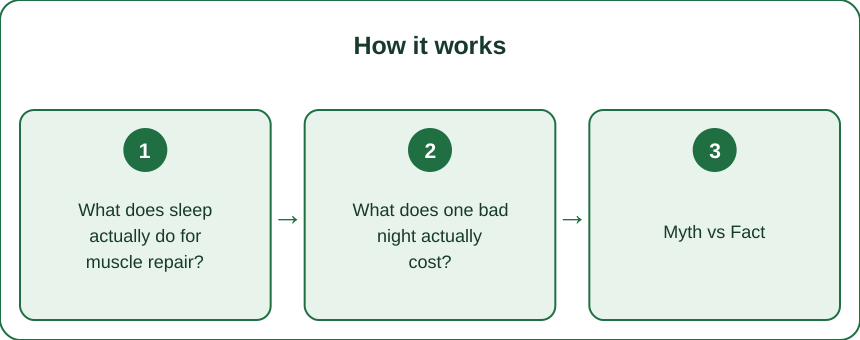
What does sleep actually do for muscle repair?
Several processes, and they are not evenly distributed across the night.
Growth hormone release peaks during slow-wave sleep, most of which occurs in the first half of the night. GH supports tissue repair and protein synthesis. This is why the common advice to protect the first three hours is not arbitrary — going to bed at midnight and waking at 6am does not simply shorten sleep, it disproportionately cuts the deepest, most restorative portion if the timing shifts your slow-wave sleep window.
Inflammatory regulation. Sleep restriction raises circulating inflammatory markers including IL-6 and CRP. Exercise-induced muscle damage already produces a local inflammatory response; adding systemic inflammation on top of it amplifies the soreness signal.
Protein synthesis. Muscle protein synthesis continues for 24 to 48 hours after a hard session, and studies of sleep restriction have found reduced synthesis rates and increased breakdown markers even when protein intake is held constant.
Pain perception. This one is underrated. Sleep deprivation reliably lowers pain threshold — meaning the same amount of muscle damage feels worse. Part of what people experience as increased soreness after bad sleep is a genuine change in how the nervous system reports the same signal.
So a bad night makes you both more damaged and more sensitive to the damage, which is why it compounds so noticeably.
What does one bad night actually cost?
More than most people expect, and the effect is measurable within 24 hours.
Studies restricting sleep to four to five hours for a single night have found increases in perceived exertion during next-day training, reduced time to exhaustion, and higher subjective soreness ratings following identical exercise protocols. Maximal strength holds up better than endurance — you can usually still lift near your normal weights on one bad night, but everything feels harder and recovery afterwards is slower.
The compounding pattern is where it becomes a real problem. Two or three consecutive short nights produce cumulative effects that a single recovery night does not fully undo. Sleep debt is repaid slowly, and typically requires several nights of extended sleep to clear.
The practical decision rule: after one bad night, train as planned but reduce intensity rather than skipping. After three or more consecutive bad nights, genuinely reduce volume — the session will produce more damage and less adaptation than usual, which is a poor trade.
This is also the honest explanation for the mystery of a session that produces unusual soreness with no change in load. The load did not change. The recovery capacity did.
Myth vs Fact: sleep and soreness
Myth: You can make up for bad sleep with better nutrition and supplements. Fact: Nutrition matters and it does not substitute. Studies comparing protein timing, tart cherry juice and various supplements against sleep extension find sleep to be by far the larger effect. The supplements are the rounding error.
Myth: More sleep is always better. Fact: There is a plateau. Extending sleep from six to eight hours produces large benefits; going from eight to ten produces very little for most people, though athletes in heavy training blocks do appear to benefit from more than the general population.
Myth: Napping does not count. Fact: Naps genuinely help, particularly for people who cannot extend night sleep. A 20 to 30 minute nap improves alertness without grogginess; a 90 minute nap completes a full cycle and appears to support recovery. Naps after 3pm can interfere with night sleep, which is the main constraint.
Myth: A hard workout guarantees good sleep. Fact: Hard training close to bedtime raises core temperature and cortisol and frequently disrupts sleep onset. Moderate training improves sleep; very hard evening training often does not.
Myth: Alcohol helps you sleep, which helps recovery. Fact: Alcohol shortens sleep onset and then substantially suppresses REM sleep and fragments the second half of the night. It also independently impairs muscle protein synthesis. It is the single worst thing you can do to next-day soreness.
What actually helps, in order?
Ranked by how much difference they make relative to how hard they are.
1. Consistent sleep and wake times. Larger effect than duration for most people. A regular schedule stabilises circadian timing, which improves sleep quality at any given duration. Keeping wake time constant within an hour, including weekends, is the single most effective change available.
2. Protect the window before bed. Bright light in the last hour suppresses melatonin. This is more about intensity than screens specifically — a dim phone is less disruptive than a bright overhead light. Dropping ambient light in the last hour is easy and effective.
3. Keep the room cool. Sleep onset depends on core temperature dropping. 16 to 19°C is the commonly cited range. As late summer nights cool through September, this gets easier — and it is worth noticing if your sleep improves for no apparent reason over the next few weeks.
4. Move hard training earlier where possible. Finishing intense sessions at least three hours before bed removes a common and invisible cause of poor sleep in people who train in the evening.
5. Caffeine cutoff. Caffeine has a half-life of roughly five to six hours, so a 3pm coffee still has meaningful levels at 11pm. Individual sensitivity varies enormously, but if you sleep badly and drink coffee after lunch, that is the cheapest experiment available.
6. Protein before bed. A modest effect but a real one — around 30 to 40g of slow-digesting protein before sleep supports overnight muscle protein synthesis. Worth doing, worth ranking last.
FAQ: Sleep and Soreness Questions, Answered
How much sleep do I actually need if I train hard?
Most adults need seven to nine hours. People in heavy training blocks often need towards the upper end or slightly beyond. The useful self-test: if you wake without an alarm within twenty minutes of your usual time, you are probably getting enough.
Does poor sleep make DOMS last longer or just feel worse?
Both, based on current evidence — the repair processes slow and the pain threshold drops. The perceptual component is likely the larger of the two for a single bad night.
Should I skip training after a bad night?
Usually no. Moderate training after one bad night is fine and often improves the following night’s sleep. Skip or reduce after several consecutive bad nights, or if you feel genuinely unwell.
Do sleep trackers help?
They are useful for spotting patterns — consistency, timing, the effect of alcohol — and unreliable for stage classification. Some people also develop anxiety about their scores, which is counterproductive. Use it for trends over weeks, not for judging individual nights.
Why am I sore for longer in the summer?
Heat disrupts sleep, and hot nights fragment the deep sleep that matters most for repair. If your soreness has lingered longer than usual this summer, warm bedrooms are a likely contributor — and it should improve as nights cool.
This is general information, not medical advice. Persistent insomnia or unusual, severe soreness deserves professional assessment.
TL;DR:
- Sleep beats every purchasable recovery intervention, and it is the only free one.
- One night under six hours raises next-day soreness through slower repair and a lower pain threshold.
- Consistent timing matters more than total duration for most people; protect the first three hours.
- Alcohol is the worst single input for next-day soreness. Evening hard training is the second.
If soreness has been lingering and you have been troubleshooting your protein intake and your stretching routine, look at the last two weeks of sleep first. It is almost always the bigger variable.
Keep Reading
This article is for general informational purposes only and is not medical advice. Always consult a qualified health professional for guidance specific to you.